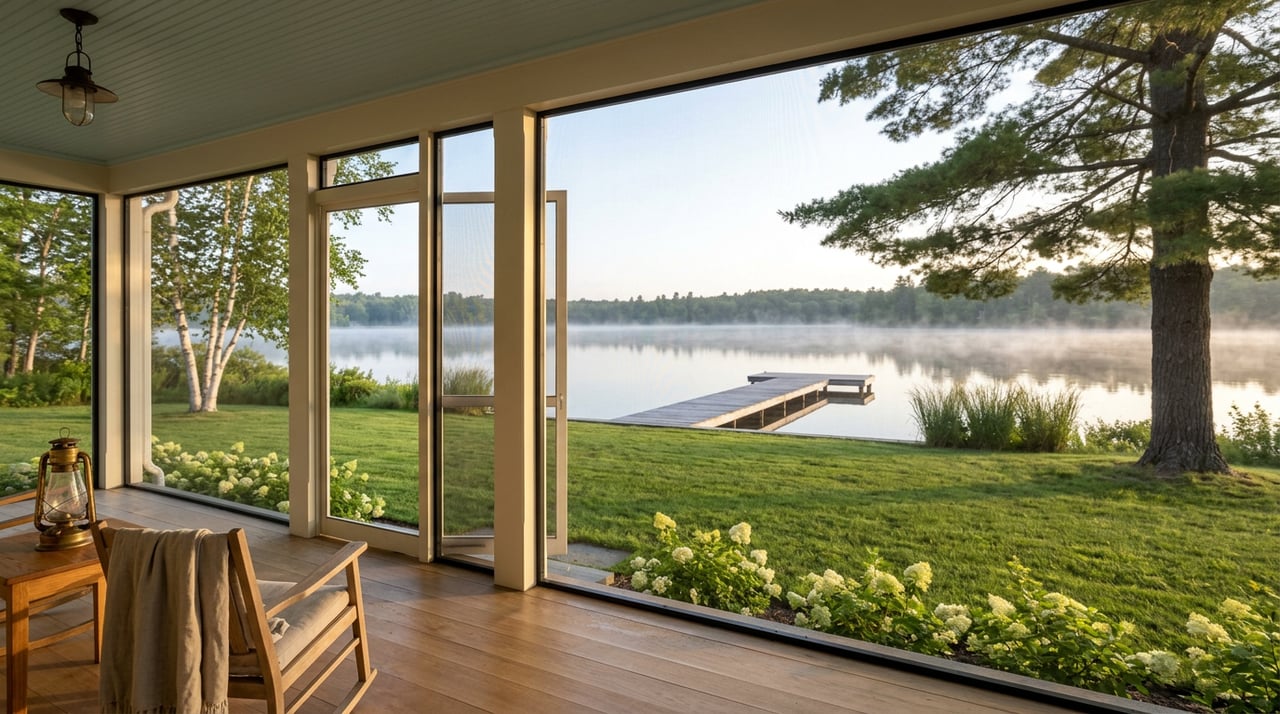
What "Gull Lake Chain" Actually Means on a 2026 Listing Sheet
July 16, 2026
July 16, 2026
Two listings crossed the Brainerd Lakes MLS this spring within a week of each other. Both used the phrase "Gull Lake Chain" in the headline. One asked just under $4 million. The other asked under $150,000. Neither price was a mistake.
The chain is not a single market. It is nine connected lakes with different bottoms, different bays, different sub-markets, and a Cass and Crow Wing County zoning overlay that quietly decides what any given lot can become. Reading a "Gull Chain" listing without decoding which lake, which access class, and which shoreland tier is like reading a Manhattan listing without checking the block.
The gap between the tiers is bigger than most buyers assume. Here is what the current inventory looked like heading into summer 2026:
| Sub-market | Avg list price | Avg $/sqft | Active listings | As of |
|---|---|---|---|---|
| Gull Lake proper | $1,581,035 | $531 | 37 | May 22, 2026 |
| East Gull Lake | — | $445 | — | 2026 |
| Nisswa lake property (mixed chain) | $897,094 | $407 | 32 | May 18, 2026 |
| Lake Shore, MN (city) | $594,799 | $357 | 8 | June 2, 2026 |
| Upper Gull Lake | $648,760 | $331 | 5 | Oct 7, 2025 |
The Upper Gull figure is older than the rest and should be read as directional rather than current. Even so, the shape holds. A buyer standing on Gull proper's Gold Coast is paying roughly sixty percent more per finished square foot than a buyer buying a home of similar size on Upper Gull or off-water in Lake Shore, for a property that touches the same interconnected water.
That premium is not arbitrary. Gull proper is 9,418 acres with roughly 38 miles of shoreline and an 80-foot maximum depth. Upper Gull is 376 acres and 25 feet deep. Both connect. Both let a boat run to the same lakeside dining docks at Ernie's on Gull, Bar Harbor Supper Club, or the Quarterdeck. What the premium buys is the open-water sightline, the sunset exposure across a big-lake fetch, and the resale liquidity of a market with 37 active comps instead of five.
Buyers who search "Gull Lake Chain" on a portal are pulling listings from Gull proper, Upper Gull, Nisswa Lake, Spring, Love, Round, Bass, Roy, Margaret, and Spider. The bays on Gull proper carry their own micro-markets. Steamboat Bay and Wilson Bay trade at Gull-proper pricing. Hole-in-the-Day Bay behaves similarly. Pine Beach Peninsula in East Gull Lake trades on scarcity of level frontage. A property "on the Chain" in Lake Margaret or Spider Lake is a different asset than one on Gull proper, even when both use the same phrase in the first line of the listing.
The interpretation problem cuts the other way too. A quiet-water buyer who wants to kayak at dawn and would find Gull proper's summer boat traffic disqualifying is often overpaying by shopping the wrong tier. Upper Gull's shallower profile, the protected bays on Roy Lake, and the smaller acreage of Spring and Love mean the same dollar buys a different lifestyle, not a lesser one.
The middle of the chain market is deeded and shared-access product. This is where the price mechanics get interesting, and where the friction hides.
Each of these lets a buyer enter the chain lifestyle at Upper Gull or off-water pricing rather than at $531 per foot. What varies, contract to contract, is how many dock slips the association actually holds, whether the slip conveys with the deed or rotates, what the boat storage rules are, and whether short-term rental is permitted. That last question in particular has shifted enough across Crow Wing County developments in the past two years that a 2022-era assumption about rental income no longer holds. This is friction that only surfaces during due diligence, not on the listing sheet.
The second mechanism most buyers miss is the shoreland overlay. In Crow Wing County the shoreland zone extends 1,000 feet from a lake and 300 feet from a stream, and a shoreland alteration permit is required for most dirt-moving and vegetation removal inside that zone. That single line changes what a mid-tier cabin buyer is actually purchasing.
State shoreland rules cap impervious surface at 25 percent of the lot area. Guest cottages cannot exceed 700 square feet or 15 feet in height. Structures in residential shoreland districts are generally held below 25 feet. Local ordinances can be more restrictive than the state minimum, and on the Gull Chain, they often are.
The rule that catches buyers off guard sits deeper in the ordinance. Under Minnesota Statute 394.36 Subd. 4, existing nonconforming structures may be repaired, replaced, restored, maintained, or improved, but not expanded. A 1970s cabin sitting 40 feet from the ordinary high water level, on a lot that no longer meets current setback or minimum-frontage standards, can be maintained forever. It cannot be pushed out toward the water, and often cannot be pushed up either. The path to a modern year-round home on that footprint is a full teardown-and-rebuild inside the current setback, not the addition the buyer sketched on the plane ride up.
Two operational consequences for pricing:
Cass and Crow Wing counties split jurisdiction across parts of the chain, most visibly around Upper Gull. Where classifications overlap due to close proximity of public waters, the boundary is drawn on the natural topographic divide. In practice this means two adjacent parcels can sit under different county land services offices, with different permit turnaround times and different interpretations of the same state rule. The listing sheet does not say which office issues the permit.
The thesis is simple. The chain-wide "Gull Lake" average is not a useful number. Three questions determine what a buyer is actually paying for:
Get those three right and the $531-versus-$331 gap resolves into a rational choice between two different assets. Get them wrong and the buyer is either overpaying for the wrong lifestyle or underpaying for a property they cannot legally turn into what they came for.
Is a deeded-access lot on the Gull Chain really equivalent to lakefront? No, and the pricing reflects that honestly. What deeded access buys is the lifestyle radius: the ability to run a boat to Ernie's on Gull, fish Steamboat Bay, and be part of the chain's summer rhythm. What it does not buy is the private frontage, the unshared dock, or the resale narrative of a Gull-proper address.
Does inventory scarcity mean waiting is a losing strategy? On Gull proper, with 37 active listings and thin turnover on the best bays, the marginal listing sets the comp and a single teardown can distort the average. On Upper Gull, with five active listings in the most recent snapshot, the market is less a market than a queue. Off-market channels matter more here than in most Minnesota lake segments.
Can I expand an older cabin that sits inside current setbacks? Under Minnesota Statute 394.36 Subd. 4, a legally nonconforming structure can be maintained, repaired, and replaced, but not expanded. The practical route to a larger home is usually a rebuild inside the current setback, which is a different underwrite than an addition. County land services in Crow Wing or Cass, depending on the parcel, is the correct first call before an offer.
Reading the Gull Lake Chain well is the difference between buying a lake home and buying a specific place on a specific lake. If you want a private walk-through of the current inventory with the sub-lake and shoreland analysis laid over each listing, MN Lakeshore Real Estate is set up for exactly that conversation. Schedule a Private Tour.
They are not selling because the market is hot. They are selling when life circumstances require it!
Sleep with the windows open and wake up to loons. Have a bonfire that goes until midnight.
Whether you're searching for your first lakeshore retreat or selling a legacy estate, Devon brings the network, the knowledge, and the discretion the transaction deserves. Every conversation is private. Every showing is personal.
Get In Touch With Our Team To Learn More
Address 700 N Washington Ave, Ste 101 Minneapolis, MN 55401